
Sylvania lighting team reviewing a commercial luminaire installation

Sylvania brings practical perspective to professional lighting

Our role is to make the path between a space requirement and a maintainable lighting system easier to understand.

A working history

Built around application conversations

A focused lighting organization takes shape

Sylvania's current organizational story begins in 1996, with commercial lighting, source technology and market support developing around changing efficiency and installation requirements. This date comes from the supplied brand record and is presented as company-level context, not a claim about every historic Sylvania trademark or predecessor.
LED selection becomes a system question

As solid-state lighting moved into broader commercial use, comparisons expanded beyond lamp wattage. Thermal management, driver compatibility, optical distribution and rated lifetime became connected decisions. Application teams increasingly needed photometric files and installation context alongside product data.

Controls join the everyday brief

Occupancy sensing, daylight harvesting and networked control placed commissioning considerations earlier in design. A luminaire might meet output and color targets yet still be unsuitable if the selected driver, emergency arrangement or protocol did not align with the project controls narrative.

Guidance stays grounded in the room

Today the supplied brand profile describes 1,200+ employees and service across 28 countries. Those generated-range figures provide scale context but do not replace project-specific availability checks. The useful work remains local: clarify the application, compare documented performance and preserve a serviceable handover record.

What guides the work

Start with use

Illuminance, uniformity and glare criteria are interpreted through actual tasks, users and viewing directions rather than a single headline metric.

Show the trade-off

Higher luminous efficacy can reduce connected load, while optics, CRI and visual comfort may justify a different balance for the space.

Plan for service

Driver access, replaceable components and recorded configurations matter after commissioning, especially in continuously occupied facilities.

One project, several viewpoints

Procurement, electrical contracting, lighting design and facilities teams examine different risks. Our collaborative process gives each role a place in the brief so substitutions, wiring decisions and maintenance expectations are surfaced before handover.

Specific performance remains conditional on the selected family, optic, driver, ambient temperature and installation. Samples, photometric calculations and current product documentation provide the appropriate verification route.

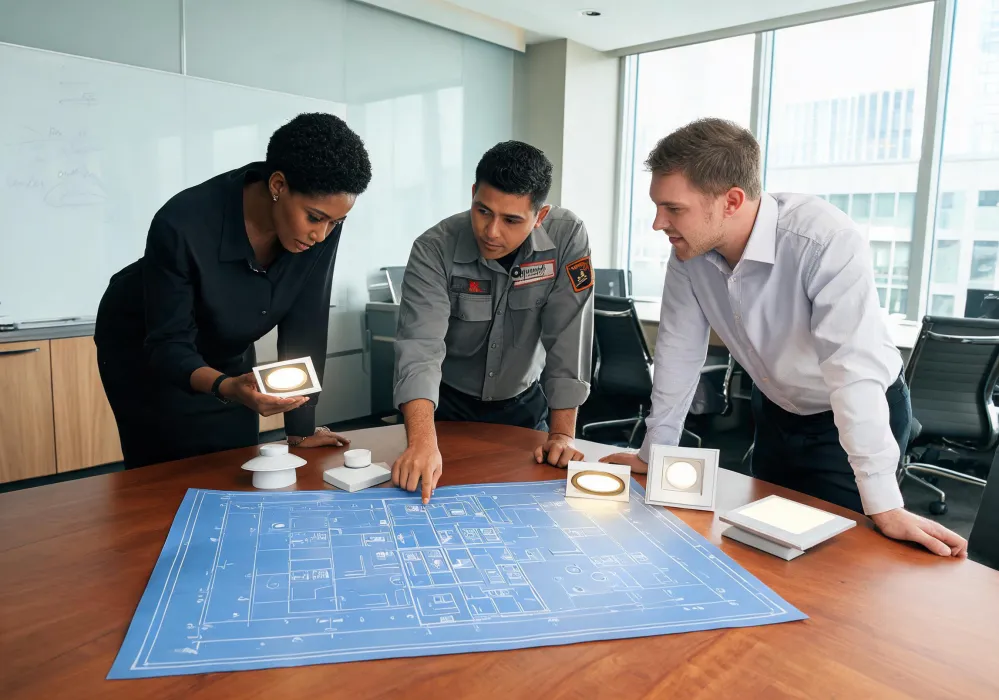
Lighting specialists and contractors reviewing a ceiling plan

Documentation by product scope

ULCERoHS

Marks and declarations apply only where listed for the exact product and destination market. Request current documentation during selection.

Let the application lead the conversation

Tell us where the light needs to work and which decisions are still open.

Meet Your Next Step