A friendlier route through the specification

The Sylvania lighting guide starts with your space

Use application, mounting and performance priorities to narrow the field. The guide does not replace a photometric calculation or current product documentation; it helps make those next steps more focused.

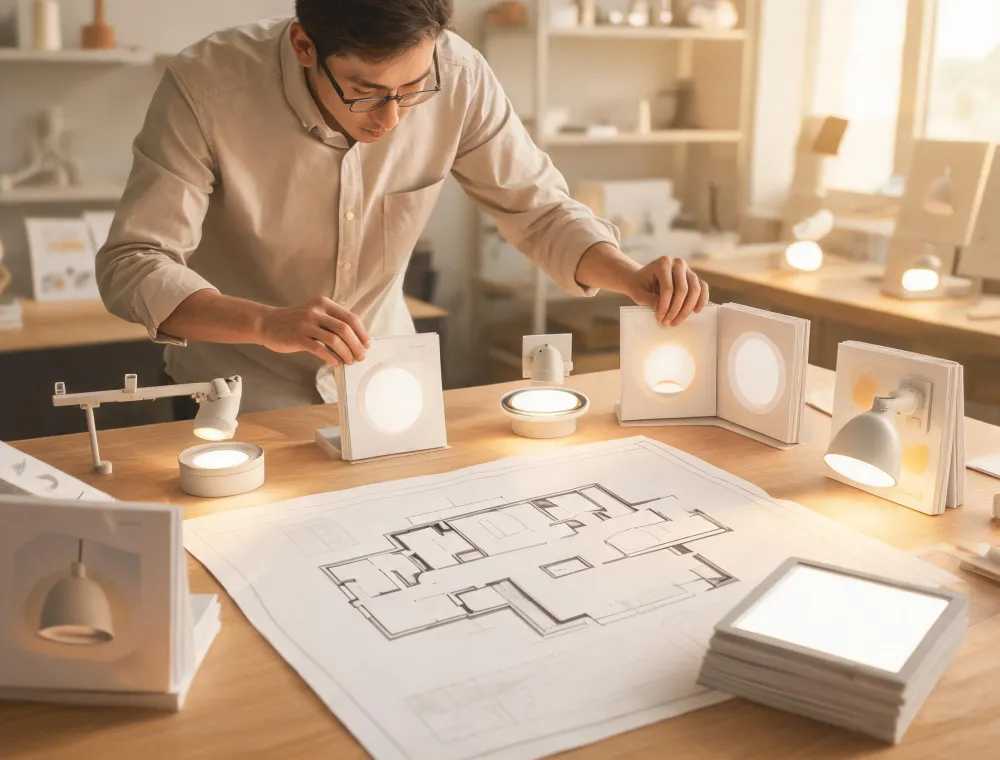
Lighting designer arranging room, task and budget selection cards

Build the brief in three passes

Application

Describe the visual work

Note who uses the room, where they look and whether screens, merchandise, faces or vertical surfaces need emphasis. Record operating hours and available daylight.

  • Office and education: glare and screen comfort
  • Retail: accent ratio and color fidelity
  • Hospitality: layered scenes and dimming
Mounting

Confirm physical limits

Measure ceiling opening, plenum depth, suspension points and service access. Retrofit work also needs existing voltage, wiring and control conditions.

  • Recessed: cutout and insulation clearance
  • Suspended: support and feed location
  • Track: loading and aiming flexibility
Performance

Set measurable priorities

Compare luminous flux in lm, efficacy in lm/W, CCT in K, CRI, beam angle and rated life. Use IES or LDT files for project calculation.

  • Example CCT: 3000 K / 4000 K
  • Example color target: Ra 80 or 90+
  • Example service context: L70 50,000 h

Selection trade-off

More light per watt is not the whole answer

A high luminous efficacy reduces connected load, which can matter in long-hour spaces. Yet visual comfort depends on how the luminaire distributes light, its apparent brightness, room geometry and viewing direction.

Compare lm/W alongside UGR information, candela distribution, CRI and the calculated result. A lower-output or wider-distribution option may be more appropriate when screen reflections or contrast are the dominant concern.

PriorityReviewLimitation
Energylm/W and control strategyHeadline efficacy does not predict room comfort.
ComfortUGR, luminance and distributionPublished UGR depends on room assumptions.
ColorCRI, CCT and TM-30 where availableOne CRI number does not describe every hue.
LifetimeL70, driver life and ambient ratingHigh ambient temperature can shorten component life.

Before approving a selection

Obtain the exact IES or LDT file, model the stated room geometry and reflectances, apply an agreed maintenance factor, and record mounting height. Compare calculated illuminance and uniformity with the project criteria. A sample installation or mock-up can then verify appearance, dimming and glare perception.

Select the control approach while the luminaire driver is still being specified. Centralized control can simplify policy management; distributed control can improve zone flexibility and fault isolation. Confirm device compatibility, wiring, addressing and emergency behavior before procurement.

Final compliance, delivered light level, product availability and exact control compatibility require current documentation and project inputs. Wet, hazardous, high-temperature or healthcare settings also need suitability checks specific to the environment and jurisdiction.

Bring one room to the table

Share the task, dimensions, mounting condition and performance priorities. A focused sample review is a practical way to compare appearance and controls before wider approval.